America has just made a fascinating decision about the future of steelmaking.
Cleveland-Cliffs is embarking on a $1 billion modernisation of its Middletown Works in Ohio, supported by $500 million from the US Department of Energy.
Its original plan was to move away from conventional blast-furnace ironmaking and towards hydrogen-ready Direct Reduced Iron and electric melting furnaces.
That plan has changed.
Instead, Cleveland-Cliffs intends to rebuild and modernise its existing blast furnace, introducing improved material handling, greater energy efficiency and AI-assisted optimisation of the steelmaking process.
It raises an intriguing question for Britain.
Could we do something similar with Queen Bess at British Steel’s Scunthorpe works?
Queen Bess isn’t simply an old furnace waiting to be replaced. Blast furnaces are rebuilt, relined and upgraded throughout their lives, and Bess has already demonstrated that new technology can be introduced into the existing ironmaking process.
In 2025, British Steel used Queen Bess for an industrial trial of Cold Agglomerated Pellets developed by UK company Binding Solutions.
Around 250 tonnes were put through the furnace. British Steel reported that Queen Bess remained stable and met the required operating parameters throughout the trial.
The technology could potentially replace up to 8% of the conventional iron-bearing burden, while the manufacture of the pellets requires substantially less energy than conventional pellet production.
Now imagine taking that experimentation much further.
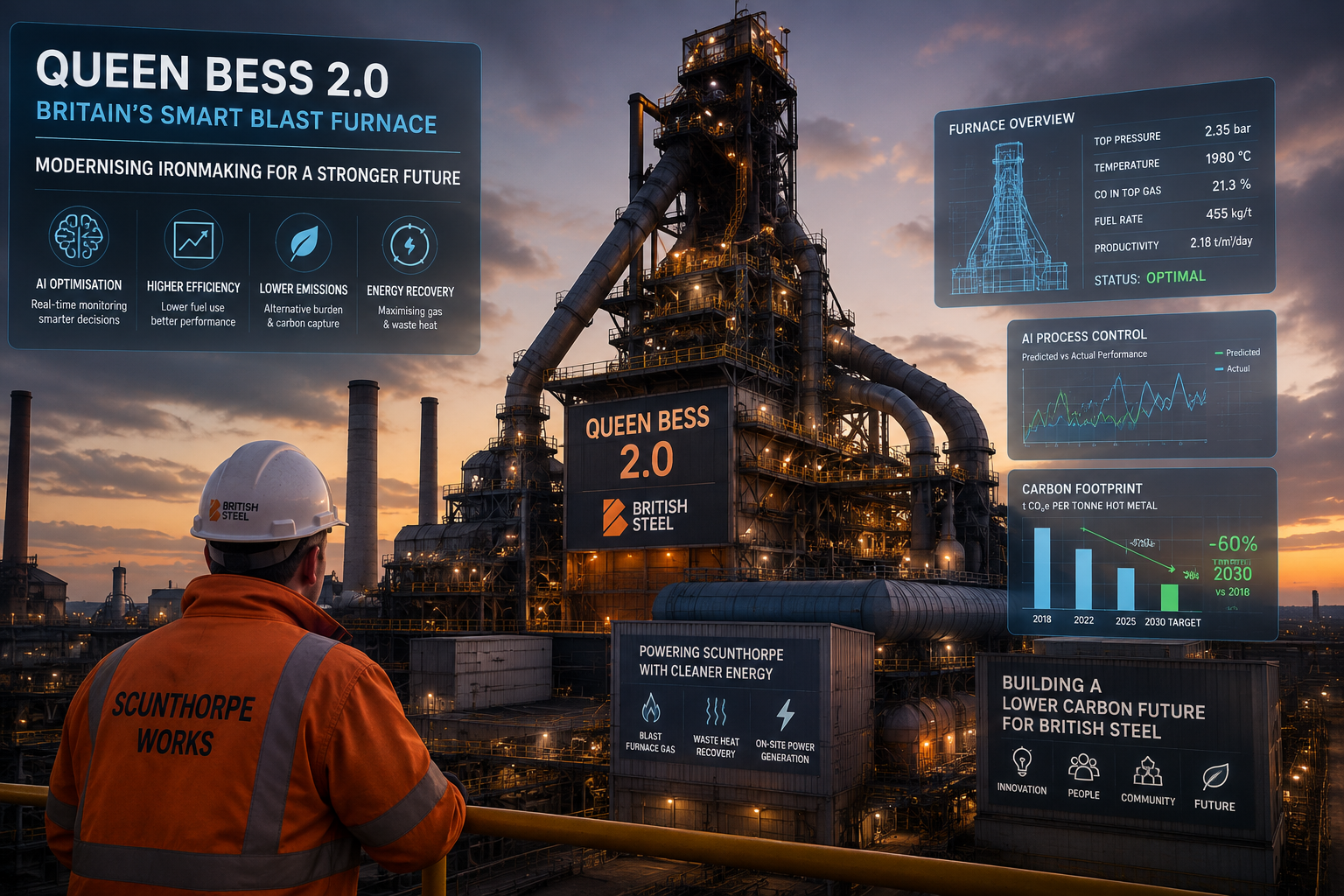
A major Queen Bess rebuild could incorporate extensive modern sensors, real-time furnace monitoring, AI-assisted process optimisation, predictive maintenance, improved burden distribution, alternative lower-carbon raw materials and better recovery and utilisation of blast-furnace gases and waste energy.
Further into the future, carbon capture could potentially tackle some of the emissions that cannot economically be removed from the blast-furnace process itself.
It wouldn’t make blast-furnace steelmaking zero-carbon.
But it raises a different possibility for Scunthorpe.
Instead of choosing simply between old blast furnaces and new electric arc furnaces, could Britain operate electric steelmaking alongside one highly modernised blast furnace?
That would preserve something strategically important: Britain’s ability to manufacture new iron from iron ore rather than relying entirely upon scrap or imported metallic feedstocks.
America is about to spend $1 billion exploring how much further conventional integrated steelmaking can be pushed.
Perhaps Britain should be asking whether Queen Bess could become Queen Bess 2.0.
Discuss